Every title in the collection comes from Shawn Ray and the BuildWithPros team, built from personal trial and error. Not theory, not trends, not generic advice
Shawn Ray is a 13× Mr. Olympia competitor with 12 consecutive top-five finishes from 1990 to 2001, the 1991 Arnold Classic Champion, and an IFBB Hall of Fame inductee
Shawn Ray competed for nearly two decades at the highest level of professional bodybuilding
1 / 1
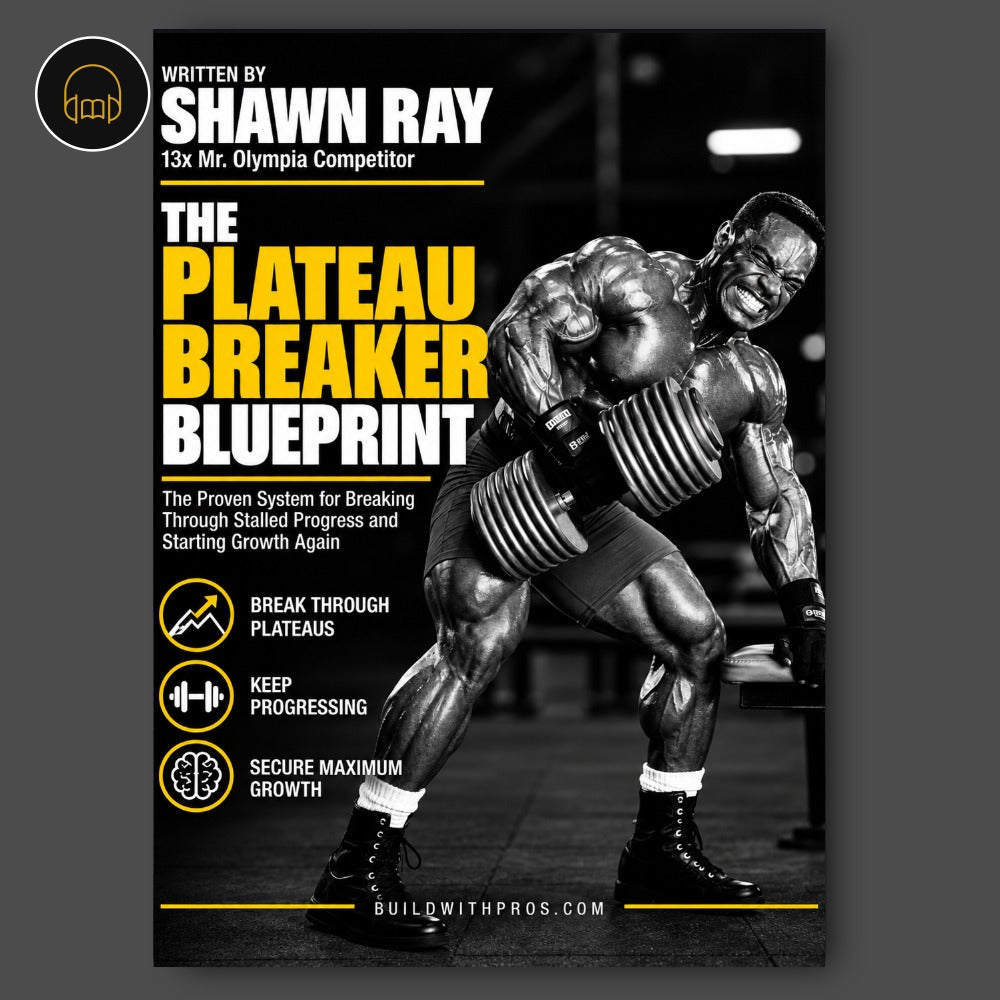
The Plateau Breaker Blueprint · Audiobook
Regular price€8,95 EUR
Regular priceSale price€8,95 EUR
Chapters
Are You Actually on a Plateau?
How to tell a real stall from an ordinary bad month, before you change anything.
Why Your Body Stops Responding.
What your body is actually doing when the work stops paying, and why that decides the fix.
Progressive Overload, Beyond Just Adding Weight.
How to keep the demand climbing in the weeks the bar will not move.
More Volume Is Usually the Wrong Answer.
Why the instinct to add sets backfires, and what to cut instead.
How Hard Is Hard Enough?
How hard a set has to be to build muscle, and where hard turns into wasted.
When to Change the Exercise, When to Stay.
When a swap is worth it, when it is avoidance, and the one reason that always justifies it.
Deloads and Rest Between Sessions.
How to take a lighter week without losing ground, and how to know you have earned one.
Sleep, the Cheapest Anabolic You Own.
What sleeping badly costs you in muscle, and what to protect first.
Nutrition for Breaking a Plateau.
How to feed a stall without turning the fix into fat.
Age Changes the Answer.
What genuinely changes with the years, and what gets blamed on age wrongly.
Weak Points, the Plateau That's Really One Body Part.
How to find the muscle that stopped, and the block that brings it back.
Training for the Long Haul.
How to hold the twelve together so the next stall is shorter than this one.
What you get
1 full MP3 plus chapters in ZIP
Professional narration in English
Plays in any audio app already on your phone, tablet, or computer, no extra app required
Stream the full MP3 or download everything and listen offline
Instant access after checkout, no account needed
Lifetime access, re-download anytime
Licensed for personal use only, not for sharing
How you download and listen
Instant access after checkout. Your audiobook arrives as one full MP3 plus a ZIP containing every chapter as a separate file.
The full MP3 can be streamed or downloaded. The ZIP must be downloaded, archives cannot be streamed.
Download once and the files are yours to keep on any phone, tablet, or computer.
The files play in any audio app already on your device. No extra software is needed.
If you want to keep track of which chapter you are on, a dedicated audiobook player does it better than a music app. It remembers your position between sessions, keeps the chapters in order, and lets you adjust playback speed.
BuildWithPros recommends two free options: BookPlayer on iPhone and iPad, which imports the ZIP directly, and Voice on Android, which reads the extracted folder as one book. No account required in either.
Your link never expires and no account is needed.
On iPhone and iPad Tap the download link and choose Download. The files are saved in the Files app, in the Downloads folder. Tap a ZIP file in Files and it unpacks into a folder with all the chapters. From there, play them directly or import the ZIP into BookPlayer.
On Android Tap the download link and the files are saved in your Downloads folder, which you find in your Files app. Tap the ZIP file and choose Extract to unpack the chapters into a folder. From there, play them directly or open the folder in Voice.
Want extra security? Create a free account with your checkout email, then your files are always available even without the order confirmation.
Need help? Reach out to the BuildWithPros team through the contact page.
Digital products are non-refundable once accessed.
About The Plateau Breaker Blueprint · Audiobook
The Plateau Breaker Blueprint is a 12-chapter, 2 hour 39 minute audiobook where Shawn Ray, a 13× Mr. Olympia competitor, walks through what a workout plateau is and what to do about one. Most lifters who believe they have hit one have measured wrong, and the months spent solving a problem that was never there is what the open question costs. This is professional narration, not Shawn Ray's own voice. A recorded introduction plays on this page, so you can hear the subject and the narrator before you buy.
A bodybuilding plateau is measured in weeks, not in sessions
Body weight moves 1 to 3 percent on its own across a single day. For a 200 pound lifter that is 2 to 6 pounds of noise, and lifters who think they have stopped gaining muscle are often reading it. A bodybuilding plateau is a stall lasting three to four weeks, on a program you actually ran rather than one you meant to run. Weekly averages against weekly averages is the only honest reading. Listen to the first chapter, then take one weekly average before your next check.
The body adapted, and that is most of the explanation
The answer to why am I not gaining muscle is duller than most lifters expect. A stimulus the body has adapted to stops asking anything of it, and within about three weeks of training a movement consistently the damage response drops away. That is the repeated bout effect, and it sits behind almost every stall. It also settles what the fix cannot be: never more of the same. Knowing how to break a workout plateau starts with what stopped, not with what to add.
A strength plateau is not always short of weight on the bar
A strength plateau gets read as a load problem when a muscle building plateau is usually a total-work problem. Three sets of eight becoming four sets of eight at the same weight is twenty-five percent more work done, and the muscle registers that. The reverse is just as often true. When volume is already high and recovery is short, the move is to cut it by twenty to thirty percent for a week or two, then rebuild from the lower baseline.
When to change exercises, and why muscle confusion did not survive testing
Knowing when to change exercises has a clearer answer than the gym floor suggests. Schoenfeld and colleagues tested randomized exercise rotation against fixed exercises in 2019 and found rotation produced no additional growth, with the fixed group doing at least as well. A separate study by Rauch found no meaningful difference in lean body mass between a set program and lifter-chosen exercises. What does justify a swap is joint pain on a specific movement, which is a health decision before it is a training one.
Weak point training, when the stall is one body part and not the whole body
Ninety-nine percent of what lifters blame on genetics is chronic under-training of that muscle. A large share of what gets called no progress in the gym is one body part standing still while the rest keeps moving. Weak point training puts that muscle first in the week and raises its frequency to one and a half or two sessions, with a shorter dedicated session added. Most people who try it abandon the block after eight weeks, before it had time to show.
Who should start somewhere else
A lifter in their first two years has not stalled yet and will get more from the foundations than from any of this. The audiobook is not a substitute for a coach watching your own training, and it cannot point at which of the twelve causes is yours. What it does instead is hand you all twelve, from the calorie surplus to build muscle through to the weak point block, because when a muscle growth plateau arrives you rarely know upfront which one will break it.
Two other titles sit either side of this one. Training Plateaus and Progression covers the intensity techniques used inside a single session, and The Maximum Growth Blueprint takes the body part by body part view of the same training. The audiobook is instant access after checkout, delivered as one full MP3 plus chapters in ZIP. The download link is emailed immediately, with lifetime access so you can re-download whenever you need it.
Disclaimer. The Plateau Breaker Blueprint is provided for educational purposes only and is not medical or healthcare advice. It is not intended to diagnose, treat, cure, or prevent any condition. Consult a qualified physician before starting any new training program, particularly if you are living with a medical condition or an injury. If you are chronically exhausted, losing sleep or losing appetite, that is a signal to back off rather than push. Individual results vary. Full terms in the BuildWithPros Disclaimer.
Listen to it, then rule out one cause before you change a single thing in the gym.
Frequently asked questions
Straight answers about this product
The Plateau Breaker Blueprint is a 12-chapter audiobook on what to do when training that used to build muscle stops building it. Shawn Ray works through the twelve causes in order: measurement, adaptation, overload beyond load, volume, effort, exercise selection, rest, sleep, food, age, weak points and training for the long haul. It is professional narration, not Shawn Ray's own voice.
By comparing weekly averages over at least a month, never single days. Body weight swings on its own from water, food and hormones, and a single bad session says nothing. The audiobook opens on this because acting on a stall you do not have changes things that were working, and that creates the problem you thought you had.
Usually not, and the audiobook is direct about it. When volume is already high and recovery is short, the move is to reduce it by twenty to thirty percent for a week or two, watch what improves, then rebuild from the lower baseline. Adding work to a body that is not recovering from the work it already has is the most common wrong turn.
The audiobook uses reps in reserve, or RIR, which describes how close a set finished to failure. Two reps left before failing is two reps in reserve; a set taken all the way is zero. Shawn Ray is blunt that loading a bar so heavy you grind out one or two reps builds strength rather than muscle, and that all-out effort on every set is not what most lifters need most of the time.
Sometimes, and the audiobook gives the shape of one: working weight dropped to about fifty to sixty percent of what you have been using, with sets cut roughly in half. It is one of the twelve causes rather than the answer to all of them, which is why the diagnosis comes first.
More than most lifters expect. Under sleep restriction, muscle protein synthesis drops by eighteen percent, testosterone by twenty-four percent and cortisol rises by twenty-one percent. A 2010 study by Nedeltcheva found that people in a calorie deficit sleeping five and a half hours lost sixty percent more lean mass than a matched group sleeping eight and a half.
If the goal is growth and the stall is real, the usual fix is a modest calorie surplus to build muscle: roughly five to ten percent above maintenance, which for most lifters is two hundred to four hundred calories a day, aiming for a quarter to half a percent of body weight gained per week. Bigger surpluses buy fat rather than speed.
It changes some of it. Natural testosterone production peaks in the late teens and early twenties, then declines on average by about one to two percent a year after thirty, though that figure is a population average rather than a personal forecast. The audiobook is honest that training in the second half of life is a large subject and that this chapter covers the part that bears on a stall.
No. The audiobook never sees your training, your food or your sleep, so it cannot point at your cause. What it does is lay out all twelve and how to test for each, because when a stall arrives you rarely know upfront which one is yours, and ruling the wrong ones out is most of the work.
A lifter in their first two years has not stalled yet and will get more from the foundations. It also does not contain a training program with exercises, sets and days filled in. It explains why progress stopped and what to change, so you can fix the plan you already run.
The Plateau Breaker Blueprint is 2 hours 39 minutes across 12 chapters. You get instant access after checkout, delivered as one full MP3 plus chapters in ZIP. The download link is emailed immediately, with lifetime access so you can re-download whenever you need it.
Digital products are non-refundable under EU consumer law once accessed. If delivery fails, contact BuildWithPros support and The Plateau Breaker Blueprint will be resent within 24 hours.
Free guide when you join the newsletter
Shawn Ray's bonus guide lands in your inbox: five plateau-breaking principles plus his full leg routine. No crowded inbox, and nothing sent unless it is actually worth your time. Unsubscribe whenever you like.
Choosing a selection results in a full page refresh.