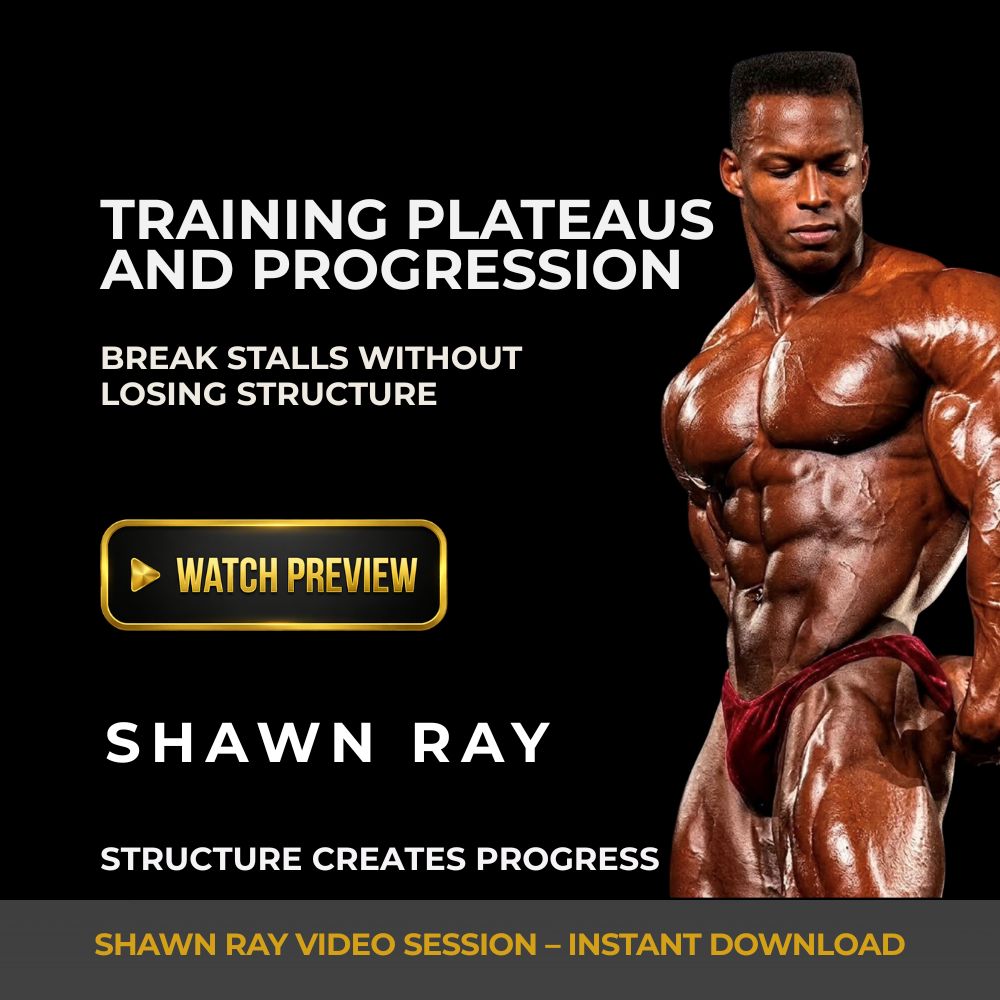
Preview clip from Training Plateaus and Progression with Shawn Ray
2 / 2
Parts in this session
Overcoming Training Plateaus: Strategies for Breakthroughs
Where to look first when the numbers stop moving, and in what order to check.
Advanced Training Techniques to Push Your Limits
How rest-pause, supersets, pyramids and eccentric work are built, and when to use them.
Making Adjustments for Continued Growth
When to adjust volume, intensity or the phase you are in, and what signals that.
Progressive Intensity: Steps to Elevate Your Training
How to raise the challenge step by step, in weight, reps, sets or frequency.
Strategies for Preventing Burnout and Sustaining Motivation
How to keep showing up when a stall drags on, without grinding yourself into burnout.
What you get
1 MP4 video file
Vertical 9:16 reels format
English audio with captions
Made to download and watch on your phone, streaming also available
Instant access after checkout, no account needed
Lifetime access, re-download anytime
Licensed for personal use only, not for sharing
How you get your video
After checkout, you receive an order confirmation by email with a link to your files. You can also click "Download your files" on the order page.
The format MP4 video in vertical 9:16 reels format. It fills your phone screen like reels and stories, and plays on all phones, tablets, and computers.
Stream or download Stream online, or download once and watch on your phone without internet. There is no limit on views. Download on Wi-Fi for a smooth download, the video files are between 300 MB and 900 MB, and mobile connections can interrupt files that size.
Your access never expires Your link never expires and no account is needed. Want extra security? Create a free account with your checkout email, then your files are always available even without the order confirmation.
Need help? Reach out to the BuildWithPros team through the contact page.
Digital products are non-refundable once accessed.
About Shawn Ray
Every video in this collection features Shawn Ray sharing the methods from his own career, built from personal trial and error. Not theory, not trends, not generic advice
Shawn Ray is a 13× Mr. Olympia competitor with 12 consecutive top-five finishes from 1990 to 2001, the 1991 Arnold Classic Champion, and an IFBB Hall of Fame inductee
Shawn Ray competed for nearly two decades at the highest level of professional bodybuilding
About Training Plateaus and Progression for Bodybuilding · Video
Training Plateaus and Progression is a 55-minute video where Shawn Ray, a 13× Mr. Olympia competitor, talks through rest-pause sets and the intensity techniques that restart stalled progress. Most lifters answer a stall by working harder at the thing that has already stopped working, and spend a season proving it. The session runs in five parts, from finding the cause to keeping the motivation intact while you fix it. A preview clip from the video plays on this page, so you can see how he handles the subject before you buy.
The routine gets assessed before anything gets added
Asking what is a training plateau is really asking which part of the machine stopped. The video starts by assessing the routine itself for the weakness that caused it, then works outward to training variety, recovery, sleep and nutrition, because those are the checks it sends you to before the program gets any harder. Diagnosis before treatment is the whole order of operations here. Watch it in one sitting, then look at your own log before your next session.
Progressive overload is the first thing to check, not the last
Progressive overload means the demand keeps climbing, in weight, in repetitions, in sets or in intensity. Most stalls turn out to be a lifter who has been repeating the same session for months and calling it consistency. The increases that hold are small, roughly 2 to 5 percent added at a time, because progression that stays gradual and balanced is the kind the body can absorb without picking up an injury on the way.
The techniques come after the basics, never instead of them
Rest pause sets complete a set to failure, take a short rest, then continue to failure again. That is what maximizes muscle exhaustion and metabolic stress. They sit inside the group of intensity techniques bodybuilding has leaned on for decades to push a muscle past what a straight set reaches. Supersets, drop sets, pyramid sets, giant sets, eccentric work, isometric holds and intra-set stretching appear in the same part of the video, integrated strategically rather than stacked.
The stimulus can change without the weight changing
Restarting progress is not only a question of load. Altering the training split, the frequency or the rep ranges gives the muscle a stimulus it has not already adapted to. Controlling tempo does the same thing from inside the set, with a slower lowering phase and an explosive lifting phase, and periodization does it by cycling between strength, hypertrophy and endurance phases rather than running one phase until it stops paying.
Who should start with another title
A lifter in their first year has not stalled yet and will get more from the foundations. Shawn Ray does not walk through exercises on screen. What it does instead is give you the order to work through when progress stops, so you change one thing deliberately rather than four things at once and learn nothing from any of them. It also covers tracking honestly: progress photos, body measurements, training logs and the recovery signals that say to cut the volume rather than push.
Two other titles pick up either side of this. The Maximum Growth Blueprint goes deeper into the intensity work and how it was actually used in a competitive career, and Bodybuilding Rest and Recovery covers the recovery half that causes more stalls than programming does. The video is delivered as instant access after checkout. A streaming and download link is emailed immediately, with lifetime access so you can return to it whenever you need it.
Disclaimer. Training Plateaus and Progression is provided for educational purposes only and is not medical or healthcare advice. It is not intended to diagnose, treat, cure, or prevent any condition. The intensity techniques it covers place higher demand on the body and suit lifters with an established training base and sound form. Consult a qualified physician before starting any new training program, particularly if you are living with a medical condition or an injury. Individual results vary. Full terms in the BuildWithPros Disclaimer.
Watch it the next time the weight has not moved for a month, and change one thing.
Frequently asked questions
Straight answers about this product
A training plateau is when progress stagnates despite continued training. Training Plateaus and Progression starts by assessing the routine itself for the weakness behind it, then works outward to progressive overload, training variety, recovery and nutrition. Shawn Ray explains which lever to pull first, so you change one thing deliberately instead of overhauling everything at once.
The lifter with enough training behind them for a genuine stall: a log that has flatlined for weeks despite honest effort. That is the point where tools like rest-pause sets belong, which is why the video expects some training history rather than a first season. A newcomer whose ordinary sets still deliver progress does not need these levers yet and can keep the session for the day that changes.
The video covers intensity techniques that spark new growth when progress stalls: rest-pause sets, drop sets, supersets and eccentric training. It also covers time under tension. The key is knowing when each is worth using and when it sets recovery back, because more intensity is not always more progress.
A drop set means continuing an exercise at a lighter weight immediately after reaching failure, extending the set to drive more stimulus. The video explains what a drop set does, when it earns its place in a plateau-breaking session, and when it only adds fatigue without adding growth.
Rest-pause sets pause briefly mid-set to squeeze out extra reps and intensify a working set. The video explains when this kind of intensity restarts progress at a plateau and when it costs more in recovery than it returns.
Progressive overload stays the foundation: challenging the muscle with small, repeatable increments. The video explains how to rebuild that progression after a stall using load and time under tension, so momentum returns through steady increases rather than one dramatic change that cannot be sustained.
No. This video does not show exercises being performed. Shawn Ray shares his experience and perspective on reading a stall and applying intensity techniques. It is filmed in vertical 9:16 format and optimized for watching on your phone.
Training Plateaus and Progression is delivered as instant access after checkout. A streaming and download link is emailed immediately, with lifetime access so you can return to it whenever you need it. It plays on phone, tablet or desktop.
Digital products are non-refundable under EU consumer law once accessed. If the link does not deliver or the video does not play, contact BuildWithPros support and Training Plateaus and Progression will be resent within 24 hours.
Free guide when you join the newsletter
Shawn Ray's bonus guide lands in your inbox: five plateau-breaking principles plus his full leg routine. No crowded inbox, and nothing sent unless it is actually worth your time. Unsubscribe whenever you like.
Choosing a selection results in a full page refresh.