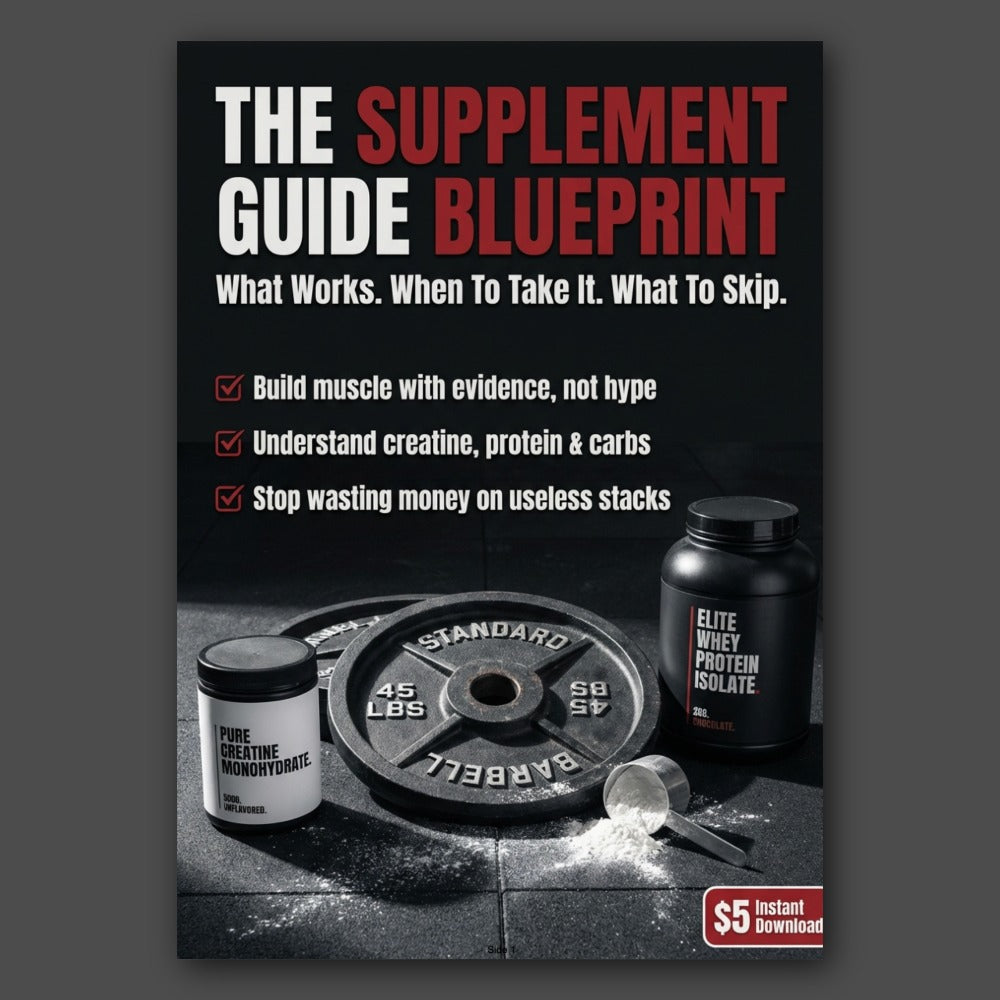
Preview.
Forty years under the bar and the premise of the whole book: supplements are helpers, not the foundation.
How Muscle Actually Grows.
Understand how muscle grows so every supplement choice makes sense.
The Fuel System.
See how the body fuels training and recovery before you buy anything.
Protein and Amino Acids.
Know what protein and amino acids actually do and how much matters.
Creatine.
Learn what creatine does, who benefits, and how to take it.
Protein Powder and the Anabolic Window.
Find out where protein powder fits and what the anabolic window really is.
Carbs, Carb Powder, and Glycogen.
Know when carb powders earn a place and when food does the job.
BCAAs and the Amino Acid Truth.
Learn what BCAAs can and cannot do before you spend money on them.
Pre-Workout, Decoded.
Decode pre-workout labels and know what you are actually paying for.
Timing, Before and After Training.
Understand what timing changes and what it does not.
Supplement Safety and Marketing Traps.
Spot marketing traps and protect both your money and your health.
Recovery and Extras.
Add the recovery extras only after the basics are in place.
Closing: The Only System You Need.
The whole approach condensed into one system you can run.
What you get
1 PDF guide
Read directly in your browser or download the file
Print friendly, print the whole guide or single pages
Works on all phones, tablets, and computers
Small file, downloads in seconds
Instant access after checkout, no account needed
Lifetime access, re-download anytime
Licensed for personal use only, not for sharing
How you get your PDF
After checkout, you receive an order confirmation by email with a link to your file. You can also click "Download your files" on the order page.
Read, download, or print Read the PDF directly in your browser from the delivery page, or download it and keep it on your phone, tablet, or computer. The file is small and downloads in seconds, no Wi-Fi needed. The PDF is print friendly, print the whole guide or just the pages you need, and bring them to the gym or the kitchen.
Your access never expires Your link never expires and no account is needed. Want extra security? Create a free account with your checkout email, then your files are always available even without the order confirmation.
Need help? Reach out to the BuildWithPros team through the contact page.
Digital products are non-refundable once accessed.
About the author
Written by the BuildWithPros team
Every BuildWithPros guide is written by the BuildWithPros team, drawing on 40+ years of combined experience in training and nutrition
The methods come from decades of personal use in the gym and the kitchen, shaped by what actually works. Not trends, not theory
Guided by Shawn Ray's standards. Shawn Ray is a 13× Mr. Olympia competitor with 12 consecutive top-five finishes from 1990 to 2001, the 1991 Arnold Classic Champion, and an IFBB Hall of Fame inductee
Shawn Ray competed for nearly two decades at the highest level of professional bodybuilding
About The Supplement Guide Blueprint · PDF
The Supplement Guide Blueprint is a 42-page PDF by Shawn Ray and BuildWithPros on the best supplements for muscle growth. Most lifters spend years paying for products that were never going to do anything, and never find out which ones those were. Eleven chapters and a closing framework go product by product, and every recommendation arrives with the dose, the timing, and the reason behind it. Every method explained, nothing left to guesswork.
What bodybuilding supplements can add, and what they sit on top of
Mechanical tension is the primary driver of muscle growth, not the burn, the soreness, or the pump. Chapter One establishes that before a single product is named, because it sets the ceiling on what any tub can add. Muscle protein synthesis stays elevated for a day or two after a hard session, so total work and total food across the week outrank any single dose. Shawn puts the order plainly: read Chapter One before your next supplement order, and the rest turns into a checklist rather than a decision.
Loading creatine, or taking the patient route
The creatine monohydrate dosage is a single number, and Chapter Four gives it along with the honest answer on the kidney question. What people get wrong is the start. Loading fills the muscle in about a week. Skipping it reaches identical saturation in three to four weeks, and both arrive at the same destination. The choice is patience against speed, and the chapter walks through when each one is worth making.
Protein per day, and the figure that moves with age
Around 1.6 grams of protein per kilogram of bodyweight a day covers most lifters, rising toward 2.2 grams while dieting hard. Past that, more protein stops buying more muscle. The figure most people miss is the one per meal, which has to clear a leucine threshold before anything switches on, and that threshold rises as muscle ages. Shawn is in his sixties and treats every meal like it has a job to do.
How supplements for bodybuilding get judged on the label
A pre-workout is judged on its formula, and three ingredients carry the evidence. Caffeine sits at roughly 3 to 6 milligrams per kilogram of bodyweight, taken about sixty minutes before training, and more is not better: around 9 milligrams per kilogram brings anxiety, a racing heart, and wrecked sleep rather than performance. Beta-alanine builds carnosine over weeks of daily intake. Citrulline supports blood flow only when dosed high enough to matter.
Written for lifters who already know the basics
The Supplement Guide Blueprint assumes you already train consistently and eat real food, and it starts from there. Get that part right, Shawn writes, and every product in the book becomes a small helper on top of a solid foundation; get it wrong, and nothing in the book makes up the difference. That is exactly why it exists: the small helpers are where most of the money goes and the least of it is spent well. The closing chapter strips the field down to what is worth running for years.
The same guide is available as the audiobook edition for listening chapter by chapter, and it is included in the Complete Nutrition System. Buyers leave reviews on this page, and they are the closest thing to opening the guide before you own it. The PDF is delivered as an instant download after checkout. A secure download link is emailed immediately, with lifetime access so you can re-download whenever you need it.
Disclaimer. The Supplement Guide Blueprint is provided for educational purposes only and is not medical, nutritional, or healthcare advice. It is not intended to diagnose, treat, cure, or prevent any disease. Consult a qualified physician or registered dietitian before starting any new nutrition or training program, particularly if you are pregnant, breastfeeding, under 18, or living with a medical condition. Individual results vary. Full terms in the BuildWithPros Disclaimer.
Download the guide and put your supplement money only where it earns its place.
Frequently asked questions
Straight answers about this product
The Bodybuilding Supplement Guide covers creatine, protein powder, carb powder, BCAAs and pre-workout: what each supplement does, how to dose it, when to take it, and when it is pointless. It also includes chapters on muscle growth biology, the fuel system, insulin, amino acids, supplement safety and marketing traps, and recovery extras such as vitamin D, omega-3 and ashwagandha.
Each supplement gets its own chapter and is judged on three things: the strength of the evidence, whether the dose that works is realistic, and whether a lifter who already eats properly actually needs it. Creatine and quality protein clear that bar. Everything else is either kept for a specific use or dismissed with the reasoning explained.
Chapter Ten covers supplement safety and marketing traps: how to read a label rather than a promise, how to spot underdosing, and why a proprietary blend that hides each dose behind one total number cannot be judged at all. Chapter Eight adds a rule for pre-workouts: match the label to the evidence-based doses the guide gives for each ingredient, and treat a fraction of the research dose as window dressing. The test the guide applies is simple: an extraordinary claim needs extraordinary evidence.
Chapter Four covers how creatine saturates the muscle over weeks of daily use, why timing is irrelevant, whether a loading phase is worth doing, and what the research shows for older lifters. It also addresses the kidney concern directly and explains where that idea came from.
Yes. Aging muscle responds less to the same protein dose, so per-meal protein rises for the older lifter, closer to thirty-five or forty grams against twenty-five to thirty for a younger one. Creatine, vitamin D and omega-3 also move from optional to genuine health priorities rather than performance extras.
The guide recommends three to five grams of creatine monohydrate daily, taken whenever you remember it, because timing is irrelevant for creatine. What matters is consistency: creatine works by saturating your muscles over weeks of daily use, not by being taken at a specific moment. The chapter also covers loading, safety and what the research shows for older lifters.
The guide's answer to what supplements should I take daily is deliberately short: creatine every day, protein powder on the days food falls short, and vitamin D and omega-3 where health calls for them. Daily supplements are separated from take-it-now products such as pre-workout, so consistency goes where it counts.
A full chapter answers when and what supplements to take before and after training. Timing matters for some products and not at all for others. The guide also dismantles the anabolic window myth: the window is real but far longer and more forgiving than marketing suggests, and slightly shorter in trained lifters than in beginners.
No. The Bodybuilding Supplement Guide is brand-neutral from the first page to the last. It walks through how to read a label, which dosages actually matter, and how to spot underdosing, proprietary blends and hidden-stimulant traps, so you can buy intelligently from any reputable supplement source instead of relying on marketing.
Both. The guide assumes food and consistent training come first, and from there it works at any level: the biology chapters explain everything from the ground up, and the safety material is written with particular care for the reader who is new, coming back after time off or working around an injury. What it saves the experienced lifter is money; what it saves the newer lifter is years of buying the wrong things.
The Bodybuilding Supplement Guide is delivered as an instant download after checkout. A secure download link is emailed immediately, with lifetime access so you can re-download whenever you need it. The PDF opens in any reader on phone, tablet or desktop.
Digital products are non-refundable under EU consumer law once the files have been accessed. If the download link fails or does not deliver, contact BuildWithPros support and the Bodybuilding Supplement Guide will be resent within 24 hours.
Customers praised this evidence-based guide for cutting through supplement marketing noise. It emphasizes "food comes first" and training fundamentals, with clear guidance on creatine, protein, and pre-workout use. Reviewers valued the honest approach, noting it "saved me from buying things I don't need" and provides practical safety advice on testing and dosing.
I have wasted more money on supplements than I want to admit. This guide finally explained what actually matters. The muscle growth section broke it down simply. Train hard. Eat enough protein. Recover. Supplements support the loop, they do not replace it. The creatine chapter alone was worth it. Clear dose. No hype. Just 3 to 5 grams daily and be consistent. I also appreciated how honest the BCAA section was. If you already hit protein, you probably do not need them. This book saved me from buying things I do not need.
L
Lena
Food first — finally a guide that gets it
I was overwhelmed walking into supplement stores. This guide made it simple. The rule that food comes first changed how I think about protein powder. It is an insurance policy, not magic. The myth section helped a lot. The anabolic window is not a 10 minute emergency. You do not need to drink sugar just to spike insulin. Now I use creatine, hit my protein, and keep everything else optional.
H
Hannah Sorensen
Accurate, balanced and professionally sound
From a professional standpoint, I appreciate the clear separation between education and medical advice. The safety section addresses third-party testing, stimulant risks, and label transparency, which is critical in this industry. The creatine and protein sections are accurate and balanced. Total daily intake matters more than panic timing. This guide reinforces training, nutrition, and recovery first, and positions supplements as small tools within that structure.
M
Marcus Caldwell
Reads like a systems manual
This reads like a systems manual. The fuel system chapter connects ATP, glycogen, carbs, and creatine in a logical way. It makes supplement categories make sense instead of feeling random. The safety chapter is one of the strongest parts. Avoid proprietary blends. Watch caffeine stacking. Buy tested products. The quick reference pages are clean and useful. What to take. When. Why. What to skip.
T
Tom Coach T Alvarez
Responsible advice I recommend to my athletes
I recommend this to my younger athletes. The pre-workout chapter is responsible and realistic. Caffeine is the main driver. Beta-alanine builds up over time. Protect sleep. Do not stack stimulants. The carb powder section is solid too. Use carbs for fuel and recovery, not to chase insulin. Most importantly, it reinforces progression. Supplements only work if the training signal is there.
A
Alicia
Respects biology and cuts through marketing noise
What I love about this guide is that it respects biology. The insulin chapter clears up so much confusion. Carbs are fuel. Insulin is a delivery hormone. You do not need to chase spikes to build muscle. The stack section is practical. Beginner stack, performance stack, lean bulk stack. Clean and structured. Creatine daily. Protein when needed. Caffeine if it does not mess with sleep. It cuts through marketing noise and keeps the focus on training progression.
Free guide when you join the newsletter
Shawn Ray's bonus guide lands in your inbox: five plateau-breaking principles plus his full leg routine. No crowded inbox, and nothing sent unless it is actually worth your time. Unsubscribe whenever you like.
Choosing a selection results in a full page refresh.