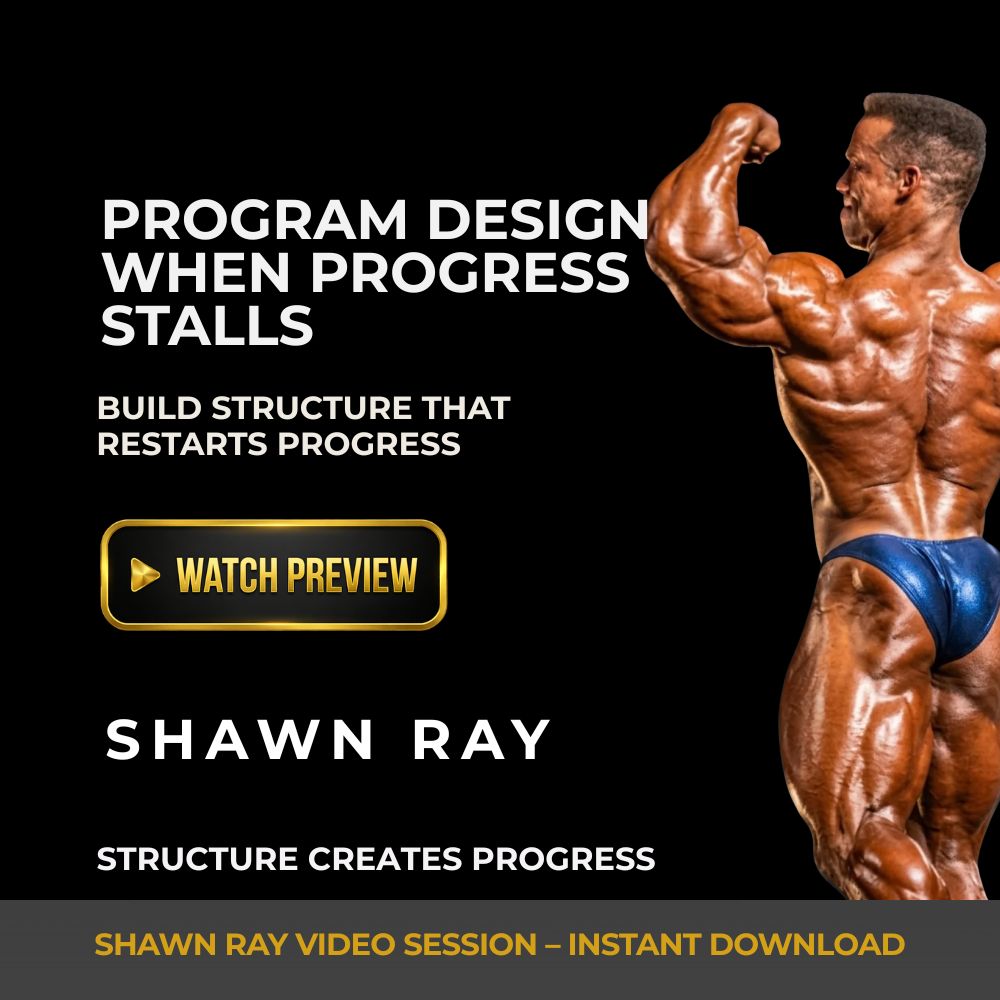
Shawn Ray bodybuilding program design video preview
2 / 2
Parts in this session
The Fundamentals of Effective Muscle-Building Workouts
What every program has to get right before anything else is added on top of it.
Training Techniques for Maximum Muscle Hypertrophy
How the intensity methods work, and where each one belongs inside a week of training.
The Art of Progressive Overload: Key to Continuous Growth
Why the demand has to keep climbing, and how small each increase should be to hold.
Designing Your Personalized Workout Routine
How to turn all of it into a week that fits your schedule, your level and your goal.
What you get
1 MP4 video file
Vertical 9:16 reels format
English audio with captions
Made to download and watch on your phone, streaming also available
Instant access after checkout, no account needed
Lifetime access, re-download anytime
Licensed for personal use only, not for sharing
How you get your video
After checkout, you receive an order confirmation by email with a link to your files. You can also click "Download your files" on the order page.
The format MP4 video in vertical 9:16 reels format. It fills your phone screen like reels and stories, and plays on all phones, tablets, and computers.
Stream or download Stream online, or download once and watch on your phone without internet. There is no limit on views. Download on Wi-Fi for a smooth download, the video files are between 300 MB and 900 MB, and mobile connections can interrupt files that size.
Your access never expires Your link never expires and no account is needed. Want extra security? Create a free account with your checkout email, then your files are always available even without the order confirmation.
Need help? Reach out to the BuildWithPros team through the contact page.
Digital products are non-refundable once accessed.
About Shawn Ray
Every video in this collection features Shawn Ray sharing the methods from his own career, built from personal trial and error. Not theory, not trends, not generic advice
Shawn Ray is a 13× Mr. Olympia competitor with 12 consecutive top-five finishes from 1990 to 2001, the 1991 Arnold Classic Champion, and an IFBB Hall of Fame inductee
Shawn Ray competed for nearly two decades at the highest level of professional bodybuilding
About Bodybuilding Program Design When Progress Stalls · Video
Bodybuilding Program Design is a 33-minute video where Shawn Ray, a 13× Mr. Olympia competitor, talks through what a hypertrophy training program has to get right. Most lifters inherit a routine from somewhere and never learn why any of it is there, so when it stops working they have nothing to adjust. The session runs in four parts, from the principles underneath every program to building one around your own week. A preview clip plays on this page, so you can hear how he explains it before you buy.
Load has to climb, and there is more than one way to raise it
The demand has to keep rising or the body has no reason to change, which is the principle the whole program hangs on. Progressive overload is the name for it, and weight is the obvious lever and the crudest one. Reps, sets, shorter rest and a slower tempo all raise the demand without touching the bar, which matters on the days a heavier load would cost you form. Watch it in one sitting, then pick the lever you will use before your next session.
Rep ranges are a mix, not a single setting
The hypertrophy rep range in this session is moderate to higher, roughly six to twelve with a weight that genuinely challenges. The video then splits it further: lower reps of six to ten under heavier loads, higher reps of twelve to sixteen under moderate ones, both in the same program rather than one chosen and kept for a year. Knowing how many reps for muscle growth matters less than knowing why each range is in there.
Volume and frequency are the two dials most people leave alone
How many sets per muscle group you run is only half the question, because the other half is how often. The video puts each muscle group at two to three sessions a week and pairs that with enough rest between them, since muscle is built during recovery rather than during the set. Balance across the body, rotating upper, lower and core work, is what keeps one area from being trained into the ground.
The rest of it is selection, form and the record you keep
Compound movements come first because they load several muscles at once, with isolation work added for whatever needs direct attention. Bodybuilding progression then depends on writing it down: a training journal turns guesswork into a pattern you can read. Failure gets used sparingly, since constant training to failure tips into overtraining, and deloading weeks exist in the program for the same reason.
Who should look at another title first
A lifter who wants a finished bodybuilding program with exercises, sets and days filled in should start elsewhere in the collection. Shawn Ray does not walk through exercises on screen. What it does instead is explain why each part of a program is there, so you can build one that fits your own schedule and fix it yourself when it stops paying. That is the part a downloaded routine never explains, and the reason it eventually stops working.
Two other titles sit next to this one. Training Plateaus and Progression takes over when a good program stops producing, and Targeting Muscle Groups covers the execution that decides whether any of it lands. The video is delivered as instant access after checkout. A streaming and download link is emailed immediately, with lifetime access so you can return to it whenever you need it.
Disclaimer. Bodybuilding Program Design is provided for educational purposes only and is not medical or healthcare advice. It is not intended to diagnose, treat, cure, or prevent any condition. Consult a qualified physician before starting any new training program, particularly if you are living with a medical condition or an injury. Individual results vary. Full terms in the BuildWithPros Disclaimer.
Watch it, then rewrite one week of your own training with a reason behind each line.
Frequently asked questions
Straight answers about this product
Bodybuilding Program Design When Progress Stalls covers how to build a hypertrophy training program from principles: progressive overload, compound lifts, rep ranges, training frequency and recovery. In 33 minutes, IFBB Hall of Famer Shawn Ray explains the reasoning behind each choice, so when progress stalls you can fix the plan itself instead of guessing.
For muscle building, the video points to moderate to higher repetitions, around 6 to 12 reps with challenging weights, with sets adjusted upward as you get stronger. The same reasoning answers how many sets and reps to gain muscle at any level: keep the challenge, progress gradually, and let the plan evolve with your strength.
The video recommends a mix rather than one number. The hypertrophy rep range spans lower rep ranges of 6 to 10 reps with heavier weights and higher rep ranges of 12 to 16 reps with moderate weights, combined with controlled tempo and time under tension for more complete muscle development than either range delivers alone.
There is no magic number, and the video says so. Shawn Ray trains each muscle group two to three times per week and adjusts total sets as strength grows, treating volume as a lever rather than a rule. Deload weeks are planned in, so the muscles and nervous system recover and long-term progress continues.
The video builds routines on compound movements first, because they drive overall hypertrophy, then adds isolation work to bring out specific muscles. Instead of a fixed count of exercises per muscle group, Shawn Ray explains how he selects movements so every exercise in the routine has a clear job.
The Bodybuilding Program Design video works for both natural lifters and competitive bodybuilders whose program has stopped delivering results. The framework Shawn Ray uses applies to any serious lifter: adjust intelligently, do not panic when progress stalls.
The Bodybuilding Program Design video focuses on how the plan itself is built: split, exercise selection, rep ranges and progression model. The Training Plateaus video focuses on breaking through stuck phases within an existing plan. They complement each other and both are included in the 7-video bundle.
Bodybuilding Program Design When Progress Stalls covers how to think in training blocks rather than single workouts: when to push, when to back off, and how phases fit together across a year. Shawn Ray shares the reasoning he applied across his career as a 13× Mr. Olympia competitor, in a 33-minute video focused on judgment, not templates.
Every method in Bodybuilding Program Design When Progress Stalls comes with its reasoning. Shawn Ray explains why a rep range, rest period, or phase is chosen, based on what held up through nearly two decades at the highest level of the sport. Every method explained, nothing left to guesswork: the goal is that you can make the same judgment calls in your own training.
No. This video does not show exercises being performed. Shawn Ray shares the experience and perspective behind program design: why a rep range, frequency or exercise selection is chosen. It is filmed in vertical 9:16 format and optimized for watching on your phone.
A streaming and download link is emailed immediately after checkout, with lifetime access so you can return to it whenever you need it. The video is filmed in vertical 9:16 format, optimized for watching on your phone whenever you need to redesign your training.
Digital products are non-refundable under EU consumer law once accessed. If the link fails to deliver or the video does not play, contact support and BuildWithPros will resend it within 24 hours.
Free guide when you join the newsletter
Shawn Ray's bonus guide lands in your inbox: five plateau-breaking principles plus his full leg routine. No crowded inbox, and nothing sent unless it is actually worth your time. Unsubscribe whenever you like.
Choosing a selection results in a full page refresh.