Every title in the collection comes from Shawn Ray and the BuildWithPros team, built from personal trial and error. Not theory, not trends, not generic advice
Shawn Ray is a 13× Mr. Olympia competitor with 12 consecutive top-five finishes from 1990 to 2001, the 1991 Arnold Classic Champion, and an IFBB Hall of Fame inductee
Shawn Ray competed for nearly two decades at the highest level of professional bodybuilding
1 / 1
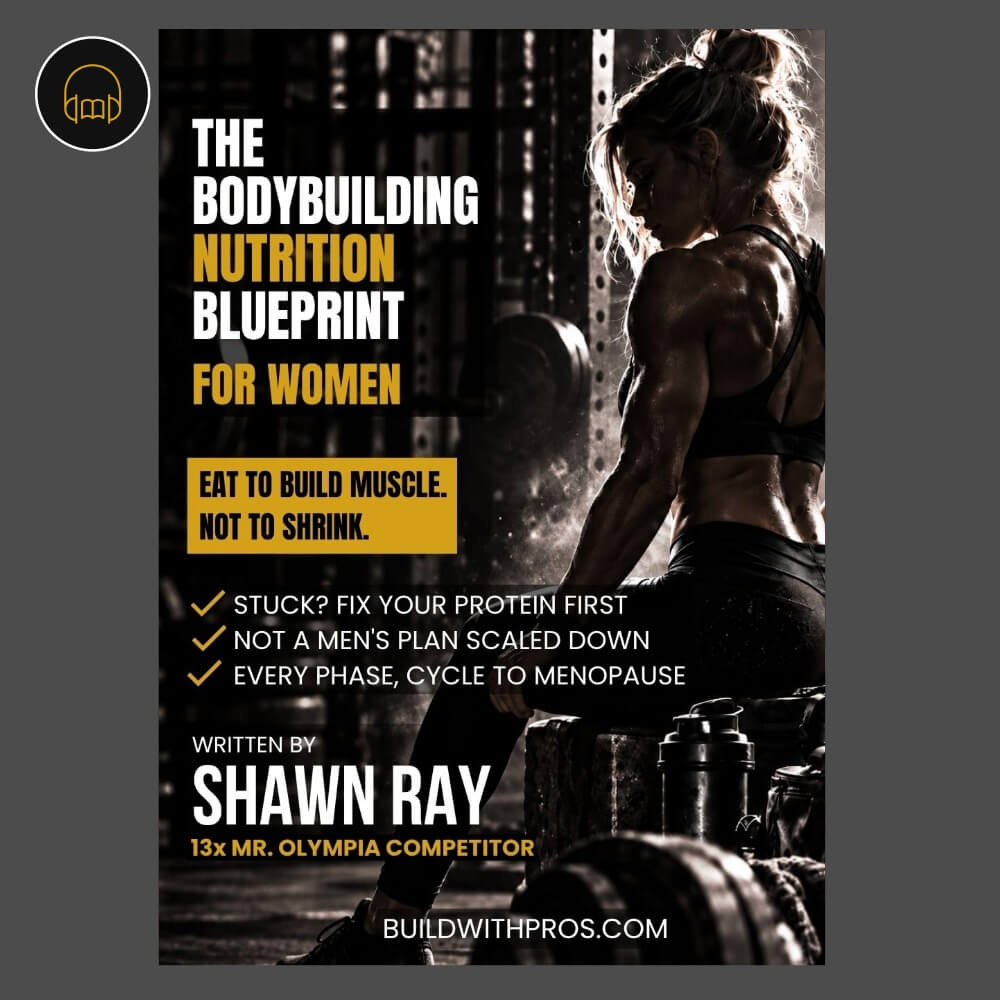
The Bodybuilding Nutrition Blueprint for Women · Audiobook
Regular price€9,95 EUR
Regular priceSale price€9,95 EUR
Chapters
The Nutrition Mindset for the Serious Female Lifter.
Why the same foundation holds for a woman who trains for real.
Offseason, Maintenance, Leaning: Same Foundation, Different Control.
How building, holding and leaning run on one system with different levels of control.
Meal Rhythm, Grocery, and Meal Prep.
What to buy and when to eat so the week runs itself.
Calories, Energy Balance, and the Macros That Matter.
How to set your starting numbers without weighing every gram forever.
Protein: The Female Lifter's Anchor.
How much protein you need per meal, and why the target climbs with age.
Carbs and Fats: Fuel, Hormones, and Why Women Cut Them Wrong.
Why cutting either too far costs training, hormones and a regular cycle.
Hydration, Iron, Calcium, and Vitamin D.
Which quiet shortfalls limit your training, and when to ask for a blood test.
Energy Availability and the Line You Do Not Cross.
What under fueling shuts down first, and how to hear it early.
The Menstrual Cycle, Training, and Fueling.
What the research supports about training through your cycle, and what it does not.
Perimenopause: What Actually Changes.
What shifts hormonally in the transition years, and which habits carry the most weight.
Menopause and Beyond: Muscle, Bone, Consistency.
How to protect muscle and bone through the decades that follow.
Building the Plan and Training for the Long Haul.
How to turn all of it into something you will still run next year.
What you get
1 full MP3 plus chapters in ZIP
Professionally produced AI narration in English
Plays in any audio app already on your phone, tablet, or computer, no extra app required
Stream the full MP3 or download everything and listen offline
Instant access after checkout, no account needed
Lifetime access, re-download anytime
Licensed for personal use only, not for sharing
How you download and listen
Instant access after checkout. Your audiobook arrives as one full MP3 plus a ZIP containing every chapter as a separate file.
The full MP3 can be streamed or downloaded. The ZIP must be downloaded, archives cannot be streamed.
Download once and the files are yours to keep on any phone, tablet, or computer.
The files play in any audio app already on your device. No extra software is needed.
If you want to keep track of which chapter you are on, a dedicated audiobook player does it better than a music app. It remembers your position between sessions, keeps the chapters in order, and lets you adjust playback speed.
BuildWithPros recommends two free options: BookPlayer on iPhone and iPad, which imports the ZIP directly, and Voice on Android, which reads the extracted folder as one book. No account required in either.
Your link never expires and no account is needed.
On iPhone and iPad Tap the download link and choose Download. The files are saved in the Files app, in the Downloads folder. Tap a ZIP file in Files and it unpacks into a folder with all the chapters. From there, play them directly or import the ZIP into BookPlayer.
On Android Tap the download link and the files are saved in your Downloads folder, which you find in your Files app. Tap the ZIP file and choose Extract to unpack the chapters into a folder. From there, play them directly or open the folder in Voice.
Want extra security? Create a free account with your checkout email, then your files are always available even without the order confirmation.
Need help? Reach out to the BuildWithPros team through the contact page.
Digital products are non-refundable once accessed.
About The Bodybuilding Nutrition Blueprint for Women · Audiobook
The Bodybuilding Nutrition Blueprint for Women is a 12-chapter audiobook on nutrition for bodybuilding for women who train seriously, built on forty years of training by Shawn Ray, a 13× Mr. Olympia competitor. Most women who lift seriously spend years on advice written for male physiology or for women who do not train at all, and the cost shows up as muscle that never arrives and phases that never end. This audiobook is narrated by a professionally produced AI voice, not by Shawn Ray himself. A recorded introduction plays on this page, so you can hear the subject and how the voice sounds before you buy.
Women's bodybuilding runs on one system with three settings
Building, holding and leaning are one foundation at different levels of control, not three different diets. Most women treat nutrition as one permanent way of eating, then conclude something is wrong with them when it stops producing the result it used to. A building block takes eight to sixteen weeks before the muscle is visibly there. Maintenance carries most of the calendar, and that is where the best physique work actually happens. Listen to the opening chapter on your commute, then name the phase you are in.
Protein is the macronutrient a serious female lifter does not wing
Older muscle answers a given serving of protein less well than young muscle does. Researchers call it anabolic resistance, and it is the reason a twenty-gram meal that triggered a full muscle-building response at twenty-five triggers a smaller one at fifty-five. The fix is not exotic. Push the per-meal serving toward the thirty-five to forty gram end and hold it there, in every phase, including the ones where total food is coming down rather than going up. The numbers behind that serving are set out in how much protein should a woman have.
Female bodybuilding after 50 asks the same system for more precision
Bodybuilding for women over 40 asks the same system for more protein, not less. Three of the twelve chapters deal with what a men's plan never has to account for. Cycle phase does not meaningfully change what a group of women can do in the gym, which is thinner ground than cycle-syncing programs suggest. Falling estrogen blunts the response to both loading and food. Building does not stop in the later decades, and the chapters say which levers move and which do not. What the trials found on creatine for women over 40 belongs to the same decade.
Carbohydrates and fats are the two women cut wrong
Carbohydrates move with the phase: four to six grams per kilogram while building, three to five at maintenance, two to four while leaning. Cutting them by more than half overnight is the common failure, and trimming twenty to thirty grams a day is the version that survives contact with a real week. Fat has a floor you do not go under for long stretches, because chronically low fat intake is one of the fastest routes to irregular cycles in a female body.
Who this audiobook is not for, and what it does instead
This audiobook is not for a woman who wants a meal plan read out to her hour by hour. Instead it gives you the reasoning underneath the numbers during hours you are already walking, driving or cooking, which is what makes the figures stick rather than get looked up twice and forgotten. It takes no position on hormone therapy, which belongs with a doctor who knows your history, and it is not written for anyone pregnant or breastfeeding.
Two other titles sit either side of this one. The written edition holds the meal templates and the grocery list you will want in front of you, and The Cut Protocol covers running a leaning block in depth. The audiobook is instant access after checkout, delivered as one full MP3 plus chapters in ZIP. The download link is emailed immediately, with lifetime access so you can re-download whenever you need it.
Disclaimer. This audiobook is provided for educational purposes only and is not medical, nutritional or healthcare advice. It is not intended to diagnose, treat, cure, or prevent any condition. It is not written for women who are pregnant, breastfeeding or trying to conceive. Decisions about hormone therapy, iron supplementation or bone medication belong with a qualified clinician. Individual results vary. Full terms in the BuildWithPros Disclaimer.
Listen to it once, then change one thing and hold it long enough to read the answer.
Frequently asked questions
Straight answers about this product
Twelve chapters on nutrition for the serious female lifter, narrated by a professionally produced AI voice. Most of the length goes to the foundation: phase structure, calories, protein, carbohydrates, fats, hydration and micronutrients. Three chapters then cover the cycle and the transition years. As a nutrition audiobook it sits closer to a reference than a pep talk, and it is meant to be listened to more than once.
No. The material assumes nothing beyond an interest in lifting, and a newcomer can run the early chapters from her first structured month. The one caveat is medical rather than athletic: anyone starting out, or coming back after a long pause, should involve her clinician before changing how she eats and trains.
No. They are two separate works on one subject. The written one is what you look things up in, with the meal templates, the grocery list and the printable tracking chapter. This one runs twelve chapters instead of twenty and spends the length on the reasoning underneath the numbers, which is the part that is easier to absorb by ear than by page.
Because the wider range buys a slightly faster scale at the expense of the cycle, the recovery and the training. Mainstream advice quotes ten to twenty percent below maintenance and a loss rate up to a full percent of bodyweight a week. For a female body the narrower end is enough to move fat steadily, and twenty percent or more is rarely necessary.
Less than most women are told. Meal frequency has a minimal effect on muscle building on its own. What decides the outcome is whether each meal is large enough in protein to trigger a response, and whether you can run the same structure on an ordinary week rather than a motivated one. Shawn Ray runs six meals himself and says plainly that it is discipline, not physiology.
Per kilogram of bodyweight, no. The idea that women need less is one of two myths the protein chapter takes apart, and it costs female lifters real progress. A smaller woman needs a smaller total, but her per-kilogram need is the same or slightly higher, particularly in a leaning block and after forty.
Yes, and that is the frame for the whole book. A female muscle gain diet gets the same attention as a leaning block, with a defined surplus, a rate of gain, and a warning that the calendar should not be spent mostly in a deficit. Building muscle after menopause gets its own treatment, because the levers change while the system does not.
Yes. Female bodybuilding over 50 runs the same system with tighter control: protein at the top of the range, a fat floor that stays put, and energy availability protected rather than squeezed. Female bodybuilding over 60 is still building, not maintaining. Two of the twelve chapters cover the transition years and the decades after them, and the answer is more precision, not a different plan.
The pooled placebo-controlled trials on creatine for women over 40 and beyond found small but real gains in lean mass and lower-body strength, and nothing at all where the daily amount was too small or the lifting was missing. Creatine and weight gain in women is mostly a misreading of the scale: the early increase is water drawn into the muscle rather than fat, and creatine bloating women describe is usually that same effect and usually short-lived.
More, not less. Protein after menopause climbs because older muscle answers a given serving less well, so both the daily figure and the per-meal serving move up even in a phase where total food comes down. Missing that single shift is one of the most common reasons a woman in her fifties stops making progress on a plan that used to work.
Menopause and muscle loss run together because falling estrogen blunts the muscle-building response and because appetite, sleep and recovery all shift at once. Metabolic rate slips mostly through the muscle that went missing rather than on its own. None of it is fixed, and resistance training is the single most effective response on the list.
Neither, exactly. Perimenopause cravings and disrupted nights are common in these years without being inevitable, and they usually track eating too little and training too hard rather than the hormones alone. The chapter covers what actually changes, what does not, and which of the common patterns are worth changing your nutrition over.
A professionally produced AI voice, not Shawn Ray. The material is his, from four decades of training and from the current research, and he says plainly that he has not lived through a cycle or the transition himself. You can hear how the voice sounds in the recorded introduction on this page before deciding.
Among health audiobooks it is a short one, running 2 hours 42 minutes across 12 chapters. You get instant access after checkout, delivered as one full MP3 plus chapters in ZIP. The download link is emailed immediately, with lifetime access so you can re-download whenever you need it. Digital products are non-refundable under EU consumer law once accessed.
Customers praised this audiobook for its balance of science and practical bodybuilding experience. Highlights include chapters on recovery, female-specific nutrition, and protein. Reviewers appreciated the focus on "building strength and keeping muscle, not just losing weight" with "no gimmicks or crazy diets, just solid nutrition advice."
Protein (positive)Recovery (positive)Strength (positive)Muscle (positive)Nutrition (positive)
5 stars: 7 (100%)
4 stars: 0 (0%)
3 stars: 0 (0%)
2 stars: 0 (0%)
1 star: 0 (0%)
A
Amanda S., California
Definitely worth listening to
Really enjoyed the balance between science and real-world bodybuilding experience. The chapters on recovery and female-specific nutrition stood out for me.
C
Christine, 48
What I appreciated most was the focus on building strength and keeping muscle, not just losing weight. A refreshing approach to women's nutrition.
M
Melissa R., Texas
The meal planning and protein chapters were my favorites. Simple adjustments that are easy to incorporate into a busy schedule.
S
Sarah K.
Shawn Ray knows his stuff
You can tell there's decades of experience behind this. No gimmicks or crazy diets, just solid nutrition advice that actually makes sense.
N
Nicole Anderson
Wish I'd found this sooner
I used to focus so much on calories and not enough on fueling my workouts. This book gave me a completely different perspective.
L
Lauren P., Florida
Excellent advice - I'm Over 40
Great Audiobook
J
Jessica M.
Nutrition that makes sense for me
The chapter on perimenopause, protein and maintaining muscle were especially helpful. Really valuable information for women who take their training seriously.
Get Shawn Ray's free muscle check
Three printable pages: one check for the months you build muscle, one for the weeks you cut, and a four week sheet to track it. After that, Shawn's Sunday Reading every other week: one story from his career, one thing to try in your next week of training, and the articles worth your time. Unsubscribe whenever you like.